How Do You Know Which Equation of Motion to Use
Where s displacement. Because I want to do theory t.

Shm Equation Summary Simple Harmonic Motion Teaching Resources Math Connections Physics Teaching Ideas Physics Notes
Theres a cool geometric derivation and a less exciting plugging-and-chugging derivation.

. 1 v v0 aΔt. U initial velocity. Then let the initial velocity be u acceleration is denoted as a time period is denoted as t velocity is denoted as v and the distance travelled is denoted as s.
Dt2 and time t. A so-called initial condition such as x t 0 0 will rule out the cosine solution since x 0 B 0 according to the condition. They are still springs or pendulums pendula but with so much friction they dont overshoot.
Second Equation of Motion. 2 x x0 v0Δt ½aΔt2. You are seeing a line because your initial position is in the itexx itex direction and your initial velocity is also in the itexx itex direction.
To find the distance travelled we use. Worse now you have a dependence on some unknown tensor T so of course this cannot be the path. First Equation of Motion.
Equations of Motion Made Easy. V v 0 a Δ t vv_0a Delta t v v 0 a Δ t. In this video we will solve 2 numerical on uniformly accelerated motion by using the three equations of motion kinematic equations v uat s ut 12 at2 and v2 u22asWe will calculate the time taken in the first numerical and distance in another.
Clear all close all clc R6371e3. You must know the period of the orbit to solve Keplers third law. For the derivation let us consider a body moving in a straight line with uniform acceleration.
Euclidean vectors in 3D are denoted throughout in bold. To state this formally in general an equation of motion M is a function of the position r of the object its velocity the first time derivative of r v dr. The main equation is r double dot- mur hatr3.
So sure contracting with a rank 2 tensor will not help you in this. Fourth Equation of Motion. Dt and its acceleration the second derivative of r a d2r.
Where A B are constants. Newtons Equations of Motion also known as SUVAT equations are explained in detail here. Before the driver hits the brakes the truck is travelling at constant velocity.
We can derive four equations of motion for objects experiencing constant acceleration. Using equations of motion 1 step numerical Transcript. Another one such as x 0 a meaning the velocity be v x t a at t 0 would then give you A a ω which completely determines x t as.
I will derive these four equations below. The acceleration is the derivative of the velocity vector with respect to time. The title is pretty self explanatory.
3 v2 v02 2ax x0 These are the equations you learn in the physics class at school to calculate the velocity or end position of an object given an acceleration and a time or a distance. Created by Mahesh Shenoy. 1 v v0 a Δ t.
Well you still have the same problem as before your equation has a free index alpha while the equation you want to get has no free index. The three equations of motions are. Or equivalently the second derivative of the position vector with respect to time.
The three equations of motions are. The code that i wrote is. These are sometimes called suvat equations because of the symbols that we use.
Third Equation of Motion. 2 x x0 v0Δ t ½ a Δ t2. V² u² 2as.
The acceleration is a vector with Cartesian representation. Consider an object moving so that its velocity-time graph is a straight line. Now lets breakdown the acceleration equation step-by-step in a real example.
If the final velocity is less than the initial velocity the acceleration will be negative meaning that the object slowed down. If s s is the distance moved in time t t then since average velocity distance time s t average velocity distance time s t s t u v 2 s t u v 2. Decided to test out my new camera and microphone by recording a little derivation video.
These equations are generally the most useful because they allow for the direct. Which re-arranges to give. T time of motion.
You must know the period of the orbit to solve Keplers third law. Calculate the distance AB A B. Overdamped is like moving through molasses-you just cant get there very fast so reducing the damping is.
For an object with constant acceleration the average velocity can be given by. Now in uxy tanθ. S 1 2u vt s 1 2 u v t.
Starting with we rearrange this equation to get. 3 v2 v0 2 2 a x x 0 These are the equations you learn in the physics class at school to calculate the velocity or end position of an object given an acceleration and a time or a distance. V final velocity.
These equations are meant to be used as a group. Average velocity u v 2 Average velocity u v 2. Equations of motion relate the forces acting on a system to the motion of the system.
First Equation of Motion. These four new equations are often called the equations of motion or the kinematics equations. That is why critically damped approaches equilibrium fastest.
We have compared the upward and downw. This answer has been confirmed as correct and helpful. What is the formula for Keplers first law Equation 255 is the equation of an ellipse which is confocal with the Sun.
The first equation of motion gives the final velocity after a time t t t for these objects given an initial velocity v 0 v_0 v 0. Well do the cool geometric derivation first. These equations are referred as SUVAT equations where SUVAT stands for displacement s initial velocity u final velocity v acceleration a and time T.
There is no acceleration and therefore the equations of motion are not used. S ut ½at². Equations of motion mathematically describe the motion of a system under the influence of forces.
If you reverse them you will get the direction of your acceleration wrong. Derivation of First Equation of Motion. If you dont have a starting time you can use 0.
First equation of motion relates velocity time and acceleration. There are a couple ways to derive the equation. Such an object is undergoing constant acceleration since the slope of the graph is constant.
In particular these equations describe the motion of particles or bodies subjected to different forces. V u at. V D t 10 D 05 D 5 m v D t 10 D 05 D 5 m.
This is really three equations one for each velocity component ie. Again these kinematics equations may be used to solve any motion problem where acceleration is constant. Consider an object that starts with a velocity and maintains constant acceleration to a final velocity of as seen in the graph below.
The truck covers 5 5 m m before the driver hits the brakes.

A Level Physics Equations Of Motion Suvat Mega Pack Teaching Resources Learn Physics Physics Classroom Basic Physics

Third Equation Of Motion Derivation Explanation Teachoo Science Motion Science Equations
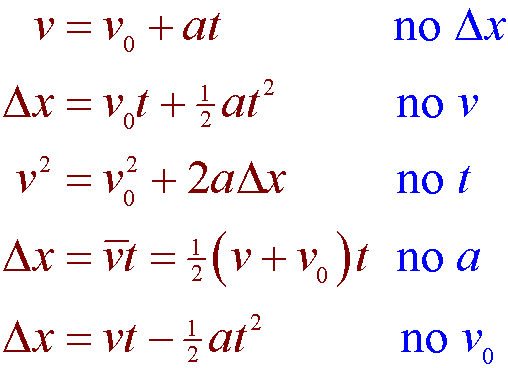
Use These Equations To Solve The Motion Problem Challenge Https Www Teacherspayteachers Com Product P Physics And Mathematics Learn Physics Physics Lessons


Comments
Post a Comment